Our new series of articles begins with a particularly impressive project: we accompany Ole Thoebel as he builds his own two-seater aircraft. From the initial idea to the construction and maiden flight, the steps involved in the project reflect above all excellence and passion for engineering. In the upcoming articles in the series, we will report on the progress and technical challenges involved in the project.
Even as a child, Ole Thoebel dreamed of flying himself. He gained his first practical experience building model airplanes before beginning to design a manned aircraft in 2015. He obtained his pilot’s license during a study trip to South Africa. After completing his mechanical engineering studies, he gained valuable professional experience in the automotive industry and motorsport over many years. Among other things, he worked with carbon fiber, a material characterized by high strength and low weight, which would later form the basis for the construction of his own aircraft.
Ole Thoebel chose the canard configuration for his aircraft, developing all of its components and systems from scratch himself in order to create a flying machine that was entirely his own vision.
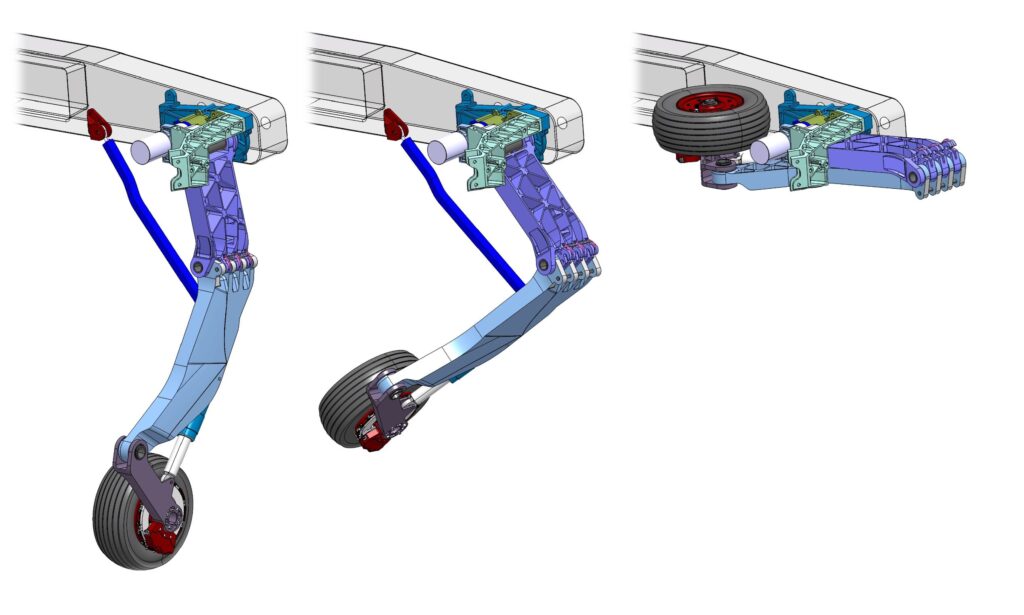
The aircraft has been in the practical construction phase for about a year. Most of the manufacturing takes place in a 30 m² workshop. Thanks to its compact dimensions of 6.8 m wingspan and 5 m length, the aircraft can be manufactured here. The fuselage shells have already been completed, while the tools for the wings are currently in production. The retractable landing gear was also developed entirely by Mr. Thoebel himself. Due to the limited installation space, a particularly space-saving design was required in order to provide sufficient volume for the fuel tank, for example.
Oliver Kube, Co-Founder and Partner of Kube GmbH, is playing a central role in this project. With his extensive expertise in carbon fiber technologies and high-performance composites, he is making a significant contribution to technical simulation – from concept validation and detailed FEM analyses to design optimization. These calculations ensure the material efficiency and structural integrity of the aircraft. He was supported by an experienced aviation expert who defined and validated the relevant load assumptions for the project. This collaboration illustrates how Kube GmbH’s expertise contributes to innovative and high-performance solutions in aviation technology.
Canard Design – The Special Aircraft Configuration
Ole Thoebel opted for the canard configuration, also known as a duck aircraft, as it meets his requirements both visually and functionally. The characteristic feature of this configuration is the horizontal stabilizer located in front of the wing.
This design not only offers a distinctive look, but also serves a functional purpose: stall usually only occurs at the front horizontal stabilizer. As a result, the aircraft only pitches down during a stall, while the airflow over the wing remains intact. With well-designed aerodynamics, this canard configuration can offer a safety advantage. While in classic aircraft the tail is located at the rear and generates downforce for aerodynamic stabilization, the canard tail at the front generates additional lift, which can contribute to overall higher aerodynamic efficiency.
At the same time, however, the canard design also has some limitations: the front wing limits the maximum lift. This results in higher landing speeds and longer takeoff and landing distances. In addition, the propeller is usually located at the rear of the aircraft, which impairs engine cooling and the airflow to the propeller.
In the next article, you’ll learn more about the engineering challenges, the methodological approach, and the solutions developed.
Follow us on LinkedIn to stay up to date.
Comments on the Project
“Motivation makes many things possible and leads us to goals that initially seem impossible.”
Ole Thoebel
“Participating in this extraordinary aircraft project is also of particular significance for us. The combination of innovative canard design, sophisticated carbon fiber technology, and precise simulation creates a collaboration at the highest professional level. This allows aerodynamic stability, structural resilience, and consistent lightweight construction to be optimally coordinated.”
Oliver Kube, Co-Founder and Partner, Kube GmbH Ingenieurbüro
We eagerly await the next steps and look forward to continuing to support this project in the future.